


(Left) Place Listening (2024) by Elysa Wendi; (Right) No Song To Sing (2021) by Chan Hau Chan and Chui Chi Yin
(左)葉奕蕾的《和椅子一起聆聽》(2024);(右)陳巧真與徐智彥的《無調人間》(2021)
CONTACT ZONING 《接觸・地帶》
Dates: 10 Nov - 15 Dec 2024
Venue: Fotoaura Institute of Photography
2F., No. 83, Chenggong Rd., West Central Dist., Tainan, Taiwan
Curators: Alfonse Chiu and Choi Sin-Yi Emilie
Artists: Chiu Chih Hua, Chan Hau Chun, Chui Chi Yin, Elysa Wendi, Lao Keng U
Organizer: Fotoaura Institute of Photography
Co-organizer: Cinemovement
Sponsor: National Culture and Arts Foundation, Hong Kong Arts Development Council
How does the body respond to migration? What are its gestural traces across lands and languages? How may we narrate the embodied histories of movement that shape identity and emotions? Curated by Alfonse Chiu (Taiwan/Singapore/USA) and Emilie Choi (Hong Kong), Contact Zoning is a group exhibition that takes as its point of departure the dense, crossing paths of migratory networks that span East and Southeast Asia which runs through the works of artists Elysa Wendi (Singapore/Hong Kong), Chan Hau Chun and Chui Chi Yin (Hong Kong), Chiu Chih Hua (Taiwan), and Lao Keng U (Macau).
A wordplay on ‘contact zone,’ a concept first coined by American critical theorist Mary Louise Pratt to describe social spaces where cultures come into contact and conflict, often while embedded in highly asymmetrical power relations, the title of the exhibition also playfully alludes to ‘contact’ and ‘zoning’ as two seemingly disparate but actually inter-linked practices that govern the urban body. While ‘contact’ as a condition of touch and physical commingling is a fundamental bio-social process for communication, ‘zoning’ is a legislative tool that serves to condition and program land through urban governance, which then choreographs what bodies can do on it. Situated in tandem, Contact Zoning thus reimagines the gestural and performative capabilities of the body as an extension and expansion of spaces, communities, and ideologies; by tracing the representational and sensuous strategies of how the body is imagined and reconstructed, this exhibition positions the corporeal politics of the body as a site of social and cultural negotiations that reflect and refract the complexities of identity and community formation.
Curatorial Essay
How does the body respond to migration? What are its gestural traces across lands and languages? How may we narrate the embodied histories of movement that shape identity and emotions? Curated by Alfonse Chiu (Taiwan/Singapore/USA) and Emilie Choi (Hong Kong), Contact Zoning is a group exhibition that takes as its point of departure the dense, crossing paths of migratory networks that span East and Southeast Asia which runs through the works of artists Elysa Wendi (Singapore/Hong Kong), Chan Hau Chun and Chui Ch Yin (Hong Kong), Chiu Chih Hua (Taiwan), and Lao Keng U (Macau).
A wordplay on ‘contact zone,’ a concept first coined by American critical theorist Mary Louise Pratt to describe social spaces where cultures come into contact and conflict, often while embedded in highly asymmetrical power relations, the title of the exhibition also playfully alludes to ‘contact’ and ‘zoning’ as two seemingly disparate but actually inter-linked practices that govern the urban body. While ‘contact’ as a condition of touch and physical commingling is a fundamental bio-social process for communication, ‘zoning’ is a legislative tool that serves to condition and program land through urban governance, which then choreographs what bodies can do on it. Situated in tandem, Contact Zoning thus reimagines the gestural and performative capabilities of the body as an extension and expansion of spaces, communities, and ideologies,
By tracing the representational and sensuous strategies of how the body is imagined and reconstructed, this exhibition positions the corporeal politics of the body as a site of social and cultural negotiations that reflect and refract the complexities of identity and community formation. Partly inspired by the writings of Canadian philosopher Brian Massumi, whose theoretical formulation of affect as a modality of response and encounter preempts the symbolic systems of socio-cultural structures, this exhibition takes as a core premise that “the skin is faster than word” to highlight and situate the tactile nature of the body as a site of ideological contention and agency.
In her new installation work, Place Listening (2024), Hong Kong-based Singapore artist and filmmaker Elysa Wendi delves into how senses may act as triggers for memories, be they real or imagined. Rooted in a series of auto-fictional exercises that draw on archival photographs from Wendi’s own personal history, this work follows and interpolates her nomadic upbringing across East and Southeast Asia over the course of her artistic career and life to probe how sight and sound may generate differential responses to the same sites and spatial contexts, and the different ways of moving through and inhabiting the intangible spaces of memory and history. Through photographs, sound, and objects, this work recalibrates the relationship between muscle memories and self-narrative, transcending the boundaries of language and geography to locate her own history within that of others.
Next, in Hong Kong artists Chan Hau Chan and Chui Chi Yin's No Song To Sing (2021), a spatial intervention transforms the linear logic of a traditional narrative cinema to invite audience members to choose from five different takes of the same scene, altering the trajectory of an intimate peep into the works and days of Hong Kong's urban poor. Originally an experimental documentary that blurs the lines between fact and fiction through vignettes alternating between the stark realities of material privation with surreal episodes of escapism that speak to the inner lives of those living on the margin, this iteration of Chan and Chui’s work poses the challenge of re-enactment to the viewer who cannot rewind time, but who can now liberate the body and the image from the laws of causality, at least through editing.
Meanwhile, Taiwanese artist Chiu Chih Hua's expanded moving image Every Movement is a Silent Utterance (2024) expands the possibilities of how media and mediation co-constitute each other by examining the role of image-making within the larger fields of visual culture, including performance, design, and cinema. Breaking down ‘image’ to its fundamental elements, Chiu investigates how the body can be archived and replicated through different compositional experiments that position the body and its rehearsals as tactics for resisting the monumentality of the archival imaginary.
In Macau artist Lao Keng U's film installation Beco Da Rede (2024), this sentiment is refracted through a spatial lens: working between figurative and abstract keys, Lao uses experimental imagery to intervene in the landscape and historical narratives of the city, exploring how individuals seek agency. Locating a narrow alley in Macau as an urban stage, Lao invites residents with different identities to perform, highlighting both the physical limitations of the body within particular social scenes but also the ways through which performance adapts and appropriates public space in the expression of self and the relationship between self and society. Through this expansion of Macau's urban space into a performative field, Lao reflects on the specific and specified relationalities between body, space, and politics as a choreographic agent.
Ultimately aiming to sketch a new cartography for performative geographies and bodies, Contact Zoning is an invitation for viewers to rethink not just what the body is but how the body is—as territory, as stage, as the world.
《接觸・地帶》
展期: 2024.11.10-12.15
地點資訊: 海馬迴光畫館
臺南市中西區成功路83號2樓
策展人: 蔡倩怡、邱上源
藝術家: 丘智華、陳巧真、徐智彥、葉奕蕾、劉景愉
主辦單位: 海馬迴藝工隊
協辦單位: Cinemovement
贊助單位: 國家文化藝術基金會、香港藝術發展局
展覽論述 (簡短版本)
當人們不斷遷徙移居,身體會產生怎樣的反應?持續流動的身體經驗塑造了異殊的身份與情感,我們又能如何敘述這些具身(embodied)的感知?由香港媒體研究學者蔡倩怡及新加坡策展人邱上源共同策劃的《接觸‧地帶》以跨地域的移動路徑作為研究線索,通過四組來自不同地區的藝術創作來展開對身體的想像與重構,探索社會和文化協商所折射的身體政治。此展覽啟發自學者Brian Massumi對於情動(affect)的觀點,並進一步闡述了他的觀點—「皮膚比語言更快」,探索身體觸覺作為意識形態的爭持,以及探索空間的能動性。展覽名稱《接觸‧地帶》源於Mary Louise Pratt所提出的概念,隱喻了「接觸」(contact)和「區域劃分」(zoning)這兩個表面上看似不相關但實際上卻相互連結的實踐,此實踐過程亦成了管理與規範城市的身體的方式。「接觸」作為觸摸以及與物理融合的條件,屬形成生物社會性(bio-social)的基礎過程,並促成交流。而「區域劃分」則是一種立法工具,通過城市治理來調節和規劃土地,進而編排身體在這些土地上的行為。因此,《接觸‧地帶》重新否想了身體的姿態與表演力(performativity),作為空間、社區和意識形態的延伸與擴展,展示不同藝術家的裝置和動態影像作品。
現居香港的新加坡藝術家葉奕蕾的全新裝置作品《和椅子一起聆聽》穿棱於真實與想像之間,探討感官如何作為觸發記憶的因素。作品沿用了藝術家的個人照片與寫作實驗,追溯其藝術生涯和生活中的遊牧旅程。她通過照片、聲音、文字與物件來尋索與形塑身體和自我敘述,並穿越邊界、語言和歷史的界限,重新組織並賦予敘事,串連起自身與他方歷史。
香港藝術家陳巧真與徐智彥的《無調人間》突破線性的敘事方式,並讓影像中反覆演練的身體可從各種身體感應與動作裏挖掘各種自身的能動性,連結在規訓與意識以外被忽略的微小感知。
台灣藝術家丘智華的影像創作擴延影像裝置《每個動作都是一個未曾說出的字詞》探究影像與其他物質媒介交融的可能性,嘗試探索身體的「複製性」、「檔案性」,並以影像來記錄、重新詮釋及創建這些身體與空間的不同敘述方式,將重覆排練的身體視作介入「檔案」的異質概念,模糊身體的流動性與作為歷史雕像的記憶及時間性(temporality)。
澳門藝術家劉景愉的《魚網里》以一條窄巷作為城市中的「舞台」,並邀請城市中不同身份的居民在窄巷中展演。一方面,作品既以城市中的具體空間來展示身體的局限性。另一方面,通過影像的再現,澳門的城市空間隨之被轉化為展演性的場域,引領觀者思考深埋澳門的社會政治處境。
展覽論述 (詳盡版本)
當人們不斷遷徙移居,身體會產生怎樣的反應?持續流動的身體經驗塑造了異殊的身份與情感,我們又能如何敘述這些具身(embodied)的感知?由香港媒體研究學者蔡倩怡及新加坡策展人邱上源共同策劃的《接觸‧地帶》以跨地域的移動路徑作為研究線索,通過四組來自不同地區的藝術創作來展開對身體的想像與重構,探索社會和文化協商中的身體政治。此展覽啟發自學者Brian Massumi對於情動(affect)的觀點,他認為「皮膚比語言更快」—情動往往比意識更早出現,因前者屬(物理)世界中相遇的外部;後者乃源於社會文化所產生的符號系統。此展覽進一步闡述了他的觀點,探索身體觸覺作為意識形態的爭持,以及探索空間的能動性。這四組作品既展示身體在四種地域、空間、歷史的座標中如何勾勒了跨地域的流徙與個人在社會集體中的具身化(embodiment),同時亦成為物質文化與社會關係的明證(manifestation)。
展覽名稱《接觸‧地帶》是對「接觸區」(contact zone)概念的文字遊戲,該概念最早由學者Mary Louise Pratt提出,以描述社會空間裏無法抵抗的接觸和衝突—這些空間通常深陷於不對稱的權力關係之中。展覽的標題也俏皮地隱喻了「接觸」(contact)和「區域劃分」(zoning)這兩個表面上看似不相關但實際上卻相互連結的實踐,此實踐過程亦成了管理與規範城市的身體的方式。「接觸」作為觸摸以及與物理融合的條件,屬形成生物社會性(bio-social)的基礎過程,並促成交流。而「區域劃分」則是一種立法工具,通過城市治理來調節和規劃土地,進而編排身體在這些土地上的行為。因此,《接觸‧地帶》重新否想了身體的姿態與表演力(performativity),作為空間、社區和意識形態的延伸與擴展,展示不同藝術家的裝置和動態影像作品。
現居香港的新加坡藝術家葉奕蕾的全新裝置作品《和椅子一起聆聽》(2024)探討感官如何作為觸發記憶的因素,亦虛亦實。此作品根植於藝術家對其長久的遊牧經驗的自省與回溯,並從其個人歷史照片、寫作實驗以及對不同物質的椅子的著迷中,詰問視覺和聽覺如何對場域和空間肌理產生不同的反應,以及在此微觀歷史中尋索記憶和歷史的移動和存在的不同方式。她通過照片、聲音、文字與物件來尋索與形塑身體和自我敘述,並穿越邊界、語言和歷史的界限,重新組織並賦予敘事,串連起自身與他方歷史。
香港藝術家陳巧真與徐智彥的《無調人間》(2021)則是由電影轉化成藝術空間內的影像裝置,突破線性的敘事方式,讓觀眾能隨意選擇觀看影片中同一場景的五個鏡頭,而非拍攝者早已選取的最終鏡頭。這尤如反覆重演的練習—時間不能重來,但影像可從線性的路徑中解放。當每個身驅落入生活空間的框限,他們可從各種身體感應與動作裏挖掘各種自身的能動性,連結在規訓與意識以外被忽略的微小感知。
台灣藝術家丘智華的影像創作《每個動作都是一個未曾說出的字詞》(2024)則是將文字隱身為字卡、藏匿為字幕,文字在此為身體與影像之間交互的媒介,身體以字卡意涵為動機,影像則以文字內容為文本。說話的過程和語言的生產,則是牽連身體的象徵與隱喻。文字關於舞者的自身經歷、同儕與師長間的提醒,那些是未曾言說,關於無形的身體壓抑,透過身體的運動,展開一系列的身體宣示。
澳門藝術家劉景愉的《魚網里》(2024)以實驗影像介入城市的景觀與歷史敘事,並探索個體如何尋索能動性。作品以一條窄巷作為城市中的「舞台」,並邀請城市中不同身份的居民在窄巷中展演。一方面,作品既以城市中的具體空間來展示身體的局限性,將身體置於特定的社會場景之中。另一方面,他亦擴展空間與身體的可能—通過影像的再現,澳門的城市空間隨之被轉化為展演性的場域,引領觀者思考深埋澳門的社會政治處境。
《接觸‧地帶》攤陳了藝術家們長久以來有關展演與地域的藝術研究與實踐,並邀請觀眾參與對話,思索台灣、香港、澳門與跨地域的身體與未來。


(Left) Place Listening (2024) by Elysa Wendi; (Right) Every Movement is a Silent Utterance (2024) by Chiu Chih Hua
(左)葉奕蕾的《和椅子一起聆聽》(2024);(右)丘智華的《每個動作都是一個未曾說出的字詞》(2024)

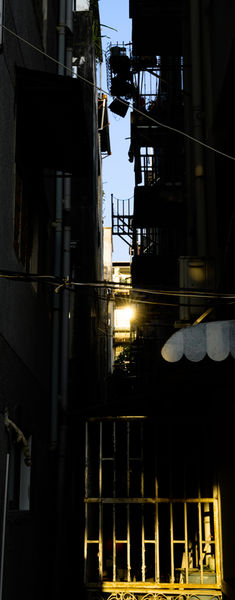

Beco Da Rede (2024) by Lao Keng U; 劉景愉的《魚網里》(2024)